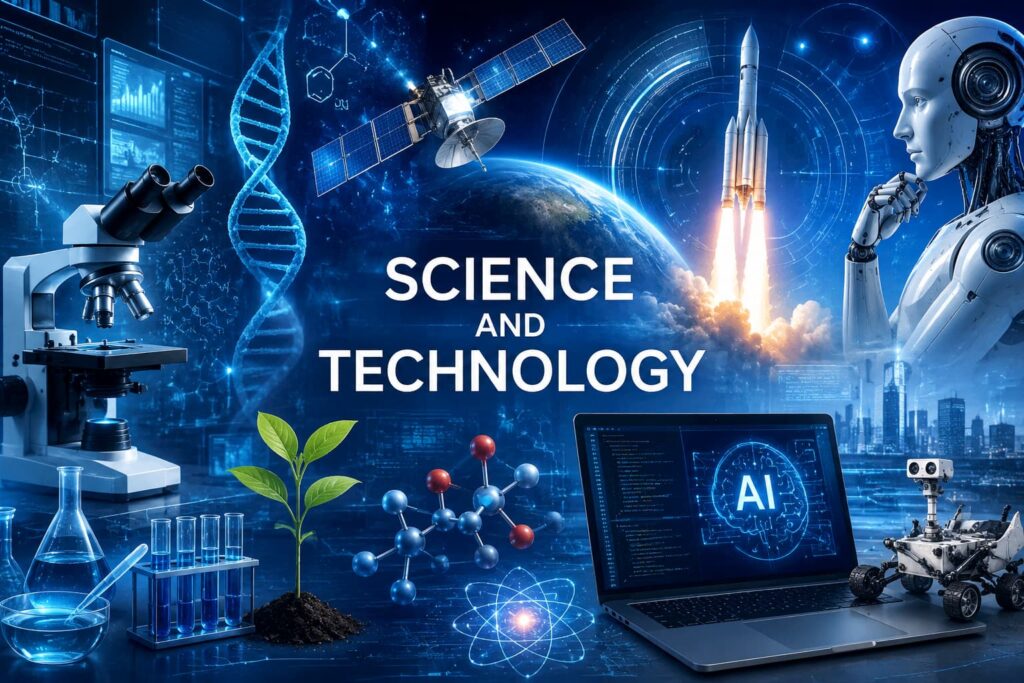
Science and Technology:
The Driving Force of Modern Life
Science and technology are no longer just subjects taught in schools; they have become an inseparable part of our daily lives. From the smartphone in your pocket to the vaccine in your body, from online classes to space missions, everything around us is a result of scientific thinking and technological innovation. As the world moves forward, understanding these fields is not just an option, it is a necessity.
What is the Difference Between Science and Technology?
Many people use these two words together, but they are different.
Science is the systematic study of the natural world. It answers ‘why’ and ‘how’. Through observation, experiment, and evidence, science helps us understand physics, chemistry, biology, and astronomy.
Technology is the practical application of that scientific knowledge. It answers ‘how to use it’. For example, science tells us how electricity flows, but technology uses that knowledge to make bulbs, fans, computers, and solar panels.
In simple words, science discovers, and technology creates.
How Science and Technology Changed Our Daily Life
Look around your house, you will see the impact everywhere.
1. Communication:
Earlier, sending a message took days. Today, a video call connects you to someone on the other side of the world in one second.
2. Education:
A student in a small town in UP can now attend a class from Harvard University through the internet. Digital libraries, apps like YouTube, and online courses have made education cheap and accessible.
3. Health:
Small diseases that used to kill people are now cured with a simple tablet. Hospitals use MRI, CT-Scan, and robotic surgery to save lives.
4. Home and Travel:
Washing machine, refrigerator, microwave, and online maps have saved our time and effort. Google Maps, UPI payment, and online shopping have made life incredibly easy.
Science has made life comfortable, and technology has made it fast.
Artificial Intelligence: The New Revolution
Artificial Intelligence, or AI, is the biggest technological revolution of our time.
AI can learn, think, and make decisions like a human. It powers our voice assistants like Siri and Alexa, recommends videos on YouTube, detects diseases from X-rays, and even helps farmers detect crop diseases with just a photo.
But AI is not perfect. It can make mistakes, copy human bias, and create problems of privacy and jobs. Therefore, AI must be used with human supervision and ethical rules. Technology should work for humans, not instead of humans.
Technology in Healthcare: Saving More Lives
Medical science has achieved miracles in the last 20 years.
Telemedicine allows a patient in Sheikhabad to consult a specialist doctor in Delhi without traveling. Wearable devices like smartwatches monitor our heartbeat and warn us about danger. New medicines and vaccines are now discovered in months, not years.
However, the challenge is access. A costly MRI machine may not reach a small village. The real success of science will be when every citizen gets the benefit of this technology, not just big cities.
The Role of Technology in Education
The classroom is no longer limited to four walls.
Teachers use smart boards and digital content to make lessons interesting. Students learn coding, design, and communication skills online. Platforms like DIKSHA, SWAYAM, and NPTEL are providing free education to millions of Indian students.
But we must remember one thing: technology is a tool, not a teacher. A good teacher’s guidance, classroom discussion, and moral values can never be replaced by a screen. Students must also learn to check if the information online is true or fake.
India’s Achievements in Space: Chandrayaan to Aditya
Space exploration is where science meets pride.
Satellites help us in weather forecasting, GPS navigation, disaster management, and communication. India’s ISRO has made the country proud worldwide. The successful landing of Chandrayaan-3 on the Moon in August 2023 and the launch of Aditya-L1 for the Sun study showed that India is now among the top space powers.
These missions do more than just land on the Moon. They create new jobs in engineering, robotics, and material science, and inspire millions of young students to become scientists.
Renewable Energy: Technology for a Cleaner Planet
Our planet is facing the biggest challenge of climate change. Science and technology are our best hope.
Solar panels on rooftops, wind turbines on hills, and electric vehicles on roads are replacing petrol and coal. Smart grids manage electricity efficiently, and new batteries store energy for night-time use.
But we must be careful. Making solar panels and batteries also uses resources and creates waste. We need sustainable policies along with new technology to truly protect the environment.
Challenges of Modern Technology
With great power comes great responsibility. Technology has brought some serious challenges:
1. Cybercrime and Fake News:
Online fraud, data theft, and misinformation are spreading fast.
2. Digital Divide:
A student with a laptop and 5G internet has more opportunities than a student without a smartphone.
3. Job Loss:
Machines and AI are replacing some manual jobs. People must learn new skills to survive.To solve this, we need digital literacy, strong cybersecurity laws, and responsible use of technology.
The Future: What Lies Ahead?
The future will be shaped by robotics, biotechnology, quantum computing, and clean energy. Scientists are working on curing cancer, growing artificial organs, and making Mars habitable.But the future will not be decided by scientists alone. It will be decided by how we use this technology. Will we use it for greed or for the good of humanity? Education, ethics, and cooperation will be the keys.Young students today should not just learn to use technology, but also learn to question it, improve it, and control it.
Conclusion
Science and technology are the two wheels of progress. They have made our lives longer, healthier, richer, and more connected. From a simple bulb to a Moon mission, every innovation is proof of human curiosity and creativity. However, technology alone cannot build a better world. We need wisdom, ethics, and equality alongside innovation. If we combine scientific knowledge with human values, we can solve the biggest problems of our time and create a future where progress benefits not just a few, but everyone and the planet itself.