
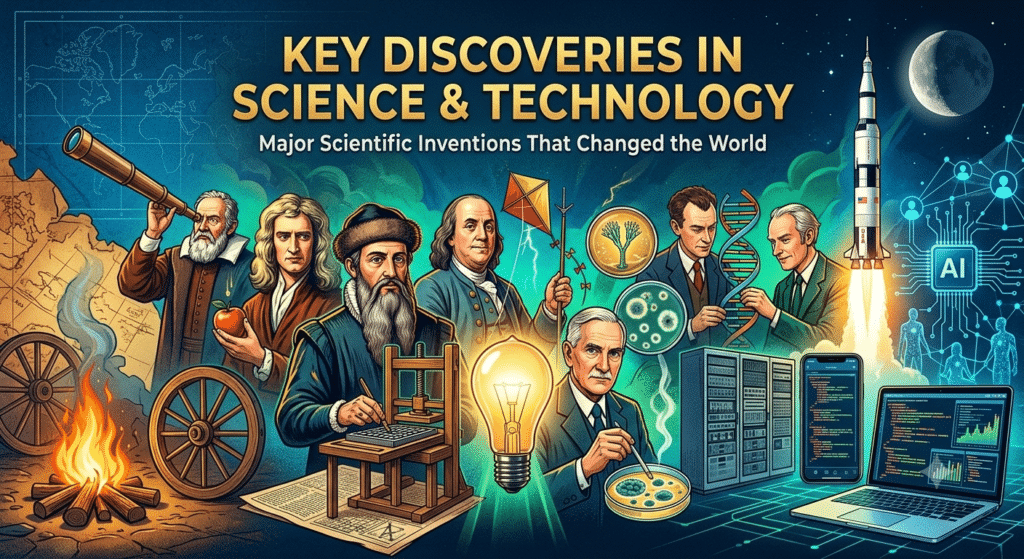
Key Discoveries in Science & Technology
Science has always played an important role in shaping human civilization. From the discovery of fire to modern artificial intelligence, scientific inventions and discoveries have transformed the way people live, work, communicate, travel, and understand the world. Many inventions that we use today are the result of years of research, experiments, and dedication by scientists. This article explores some of the major scientific inventions and discoveries that changed the course of human history.
-
Discovery of Fire
The discovery and controlled use of fire was one of the earliest milestones in human history. Fire provided warmth, protection from wild animals, and light during the night. It also made cooking possible, which helped humans prepare food more safely and efficiently. Although fire was not invented by a single person, learning how to control it was a major step in human development.
2.The Wheel
The wheel is another revolutionary invention that changed human civilization. It is believed to have been developed around 3500 BCE. The wheel made transportation easier and played an important role in agriculture, construction, pottery, and machinery. Even today, wheels are essential in vehicles, industrial machines, and many everyday objects.
-
The Printing Press
The printing press was developed in Europe by Johannes Gutenberg around the 15th century. It made the mass production of books possible and significantly reduced the cost of producing written materials. The invention helped spread education, literature, scientific knowledge, and new ideas to a much larger population.
The printing press is considered one of the most important inventions in the history of communication and education.
-
Discovery of Gravity
One of the most famous scientific discoveries is the law of universal gravitation associated with Sir Isaac Newton. In the 17th century, Newton explained that objects attract each other through gravity. His work helped scientists understand the motion of planets, the Moon, and objects on Earth.
Newton’s laws became an important foundation for classical physics and influenced scientific research for centuries.
-
Discovery of Electricity
Electricity is among the most important discoveries in modern science. Scientists such as Benjamin Franklin, Alessandro Volta, Michael Faraday, and others contributed to the development of electrical science.
The understanding and practical use of electricity eventually made possible electric lighting, motors, communication systems, computers, household appliances, and countless modern technologies.
-
The Telephone
The invention of the telephone revolutionized communication. Alexander Graham Bell is widely associated with the invention of the telephone and received a patent for it in 1876.
The telephone allowed people to communicate over long distances almost instantly. It eventually evolved into mobile phones and smartphones, which are now an essential part of modern communication.
-
The Light Bulb
The development of the practical electric light bulb changed everyday life. Thomas Edison and other inventors contributed to the development of practical incandescent lighting.
Electric lighting allowed homes, businesses, factories, and public spaces to remain active after sunset. It also improved safety and productivity in many parts of the world.
-
The Discovery of Penicillin
The discovery of penicillin by Alexander Fleming in 1928 was a major breakthrough in medicine. Penicillin became one of the world’s first widely used antibiotics and helped doctors treat many bacterial infections.
The development of antibiotics dramatically changed modern medicine and has saved countless lives by making previously dangerous infections treatable.
-
The Discovery of DNA Structure
DNA, or deoxyribonucleic acid, carries genetic information in living organisms. In 1953, James Watson and Francis Crick published a model of DNA’s double-helix structure, building on crucial experimental evidence from researchers including Rosalind Franklin and Maurice Wilkins.
Understanding DNA transformed biology and contributed to advances in genetics, medicine, biotechnology, and forensic science.
-
The Computer
The development of computers was another major technological milestone. Early computers were large machines designed for calculations and specific tasks. Over time, advances in electronics and computing made computers smaller, faster, and more powerful.
Today, computers are used in education, banking, healthcare, business, scientific research, entertainment, and communication. Modern digital technology would not be possible without the development of computing.
-
The Internet
The internet transformed global communication and access to information. Its development involved the work of many researchers and organizations, particularly from the late 20th century onward.
Today, the internet connects billions of people around the world. It supports online education, digital payments, social media, e-commerce, research, entertainment, and remote work.
- Space Exploration
The development of rockets and spacecraft opened a new chapter in scientific discovery. In 1957, the Soviet Union launched Sputnik 1, the first artificial satellite to orbit Earth. In 1969, NASA’s Apollo 11 mission successfully landed humans on the Moon.
Space exploration has helped scientists study planets, stars, galaxies, and Earth’s environment. Satellites also support weather forecasting, navigation, communication, and scientific research.
- Artificial Intelligence
Artificial Intelligence (AI) is one of the most important areas of modern technology. AI allows computer systems to perform tasks that can involve learning, pattern recognition, language processing, and decision-making.
Conclusion
The history of science is a story of curiosity, experimentation, innovation, and discovery. From the wheel and fire to electricity, antibiotics, computers, space exploration, and artificial intelligence, scientific progress has continuously changed human.
Read this blog Also
Indian History: A Journey Through India’s Glorious Past